Friday, August 24, 2012
Kenton Turk: The Great Read-Out #1
Friday, May 25, 2012
The Voice of the Auslaender
by Kenton Turk
If considered a concert, it would beat the legendary three-song gigs of The Jesus and Mary Chain for cutting it short by a third, but Nikko Moss's two back-to-back numbers were a long entry among the single-jab acts at the Trash Deluxe Variety Show (at AHA, Berlin, 19/05/12), a bi-monthly jumble of any and everything schräg. While the evening's show ended with two Rubinesque drag queens and a dressed-for-sex female counterpiece smearing cake all over each other's bodies (on the two-year anniversary of the first of these outings), it was something as plain as a clear voice and an acoustic guitar that stole the evening and brought out the greatest applause.
Nikko Moss comes from California, and her first number was entitled, quite without adornment, just that. “California” is an ode to leaving... a land, friends and family, a piece of yourself behind. The first line, “California, I'm not coming back to you,” brought out snickers and grunts of anticipation: it was going to be fun to hear the Golden State, the Cartoon On The Pacific, get taken apart. Yes, she misses it. No, not enough to go back. Not when she's happily partnered here. But by the time she had woven her way through the joys and doubts of the resolute expat, you had to swallow hard, if you know the situation from up close. Her voice, a classically-trained operatic instrument, effortlessly carried the words along their way through wide-eyed observation and a plea to the homeland to take care of her family. The song ended with a vow to return someday and lie enveloped in her, in California, to enrich the soil, end where she began. How many more of the transplanted have had these thoughts. Brief silence, then thunderous ovation and cries for more, and Moss smiled the smile of the surprised.
The outburst brought on a second self-penned offering, “Let's Run Away,” which told of an anticipated moment of rejection that doesn't transpire. This one showcased her abilities well too, her voice a finger tracing a silhouette line from the peaks of mountains down into the valleys, only to wander there and again ascend to the heights in single leap, but the first was her real moment. After the show, while globs of one cake were being scraped off the stage and another one was making the rounds, Moss was approached by well-wishers and back-slappers and finally by an enthusiastic stranger who shared his rapture and asked to buy a CD (there weren't any), then requested an autograph instead. From Brazil, he found Moss's melodic paean had sung his thoughts to a tee, despite differing language and location.
With the current headlong rush to Berlin from all the globe's corners, it seems clear die Zugezogenen, the newcomers, between homes found and abandoned, will need a voice as their own new flag. They may already have found theirs in an unassuming barefoot singer who beams from ear to ear and apologizes for occasionally lapsing into English. Brazil is not California, but tonight it felt that way to at least one; as such, there may be many Californias tending to the loved ones of New Berliners and waiting for the ultimate return of the native.
photo: A.B.
Tuesday, May 17, 2011
Cement eclipses
Where and when did the Cement Eclipse campaign begin?
I started making sculptures out of cement when I was at School of Art in 2002, but it was not until 2006 when I started to use them on the streets. The first place I left a Cement eclipses sculpture was in the city of Vigo
What’s the concept behind these small street pieces?
Cement Eclipses is a critic/definition of our behavior as a social mass. This project intends to catch the attention on our devalued relation with the nature through a critical look to the collateral effects of our evolution. These scenes zoom in the routine tasks of the contemporary human being. They present fragments in which the nature, still present, maintains encouraging symptoms of survival. The precariousness of these anonymous statuettes, at the height of the sole of the passers, represents the nomadic remainders of an imperfect construction of our society. These small sculptures contemplate the demolition and reconstruction of everything around us. They catch the attention of the absurdity of our existence. more
A book about the Cement eclipses will be presented Thursday 26th May 2011 6.00pm at The Pure Evil Gallery, London
Thursday, March 31, 2011
Gegen Warten | Reinhold Gottwald at a.i.p.
gegen warten
Reinhold Gottwald
a.i.p.galerie opening reception April 1st, 7pm 2.4.-7.5.2011 a.i.p.galerie artist in progress Suarezstraße 8 14057 Berlin
Sunday, October 10, 2010
part of the art
part of the art, two JGP residing inside an art work by Anett Lau
part of the art fairs, a JGP claiming to be on 7th Berlin Kunstsalon, while in fact in front of a photograph by MUT showing Toni Lin Zeidler, claiming to be part of Circus Minimus, while in fact both are at Fridey Mickel´s party at LA54
part of the artist, a JGP residing on top of Emil, one of the most influential cognitive mentors of the Berlin art scene.
Tuesday, September 28, 2010
M FOR FAKE
Marriage and Shams in Nataša Drakula’s Art
The exhibition at the Meinblau art house is prefaced by a video of the artist’s own wedding, making it very personal. A PERFECTLY NORMAL WEDDING shows observers the protagonists and the photos of an apparently joyful and cheery wedding. But are the scenes portrayed really what they seem to be?
The multichannel installation M FOR FAKE contrasts this example with other marriages – marriages of convenience, marriages for protection, sham marriages. Nataša Drakula questions various anonymous participants about their experiences and motives, their fears and desires. Through images and audio, those concerned reveal which existential discussions they had with their partners and when decisions had to be made for the sake of papers or the government.
The viewer gets an idea of the inequality of the partners in a binational marriage. The question of residency is thus a strain on every friendship, and many relationships collapse under the pressure. Even when people marry out of love, the government often suspects them of entering into sham marriages. In reference to her most recent works, Nataša Drakula says, “With this project, I am trying to show the absurd phases of life that many people are forced through and the meaning they draw from these experiences. In so doing, I hope to contribute to a better understanding between foreigners and Germans, maybe even to loosen these classifications.”
Nataša Drakula, born in former Yugoslavia, has been living in Germany since 1991. She studied at the University of the Arts Bremen and received her Master of Arts from the Berlin University of the Arts. Nataša Drakula works as an instructor of visual communication at numerous German universities and art schools and gives lectures at symposia. The Meinblau gallery is hosting the premiere solo exhibition of the artist, who lives in Berlin and on Hvar.
Tuesday, March 24, 2009
Thorsten Fleisch | 26th March | Berlin | Scala 9pm
Personal show by film and videomaker Thorsten Fleisch
followed by a music performance of his band
Malende
On first sight, his films are very abstract and conceptual. Thorsten Fleisch is working directly with materiality, which can be as analogue and direct as skin impressions or crystals growing on the surface of film surface (16mm), or as digitally generic as a reciprocal math formula that creates 4-dimensional forms, inter-cut with 3 dimensional space and finally shown on the 2-dimensional space of video screen. Material in that sense could also be the electric discharges and their traces on photographic paper. Thus following his workflow, it becomes evident, the author is working with a hybrid combination of analogue and digital image processing. However, and as he tells me, the analogue, or better saying material processes are allowing him to also use chance operations and mistakes (like a light flair on film stock) during the working procedures, whereas with code (or programming) a mistake will just result in a script-error, which has to be eliminated scrupulously instead of being able to be integrated in the creative process.
Just by reviewing the titles of his work, such as “Blutrausch” (blood rush), “Videohaut“ (video skin) “Friendly Fire”, “Kosmos” (cosmos) and “Gestalt” we may realize, on the other hand, that something more is going on with and within the artist’s working process. Without any pathos and drama in his making of, Thorsten Fleisch is lingering (or, shall we say loitering?) on existential and creational themes: light through the literally on film grown minerals are producing a pictorial cosmos, or the blood drawn from his own body is creating a (maybe delirious) rush of images. Trying to put it into a nutshell, one could say, body, creation and space are the themes of his work.
By taking an even closer look, one may also discover that the filmmaker is focusing onto a third yet to mention aspect: It is the sensuality in images that triggers his interest both in his own and in the work of others. One may call it old-school, it sometimes takes as much as a couple of years for its execution, and it may be similar to the meticulously composing and editing of the early Stan Brakhage (classic avant-garde filmmaker who combined all kinds of lens and lens-less effects with camera images to visual compositions), but it is that quality of painstakingly controlling the composing and composition towards pictorial expression that creates the quality of his films. What is new and contemporary in his work, Thorsten Fleisch uses any kind of hybrid techniques, thus challenging the meaning of the “expression of material.”
I prefer old-school and handcraftship to cold calculated superficiality, it makes me read the work on different levels while at the same time enjoying its pure sensations. In fact, Thorsten Fleisch’s work has been screened widely in galleries and on festivals including Directors Lounge.
Thorsten Fleisch will be present and available for Q&A after the screening.
Following the screening, the band … will give play …
program starts at 9 pm
doors open 8 pm
See you at the Scala, Friedrich Str. 112 A, 1st floor
Saturday, February 07, 2009
Underworld Cinema: The Life and Work of J.X. Williams
"Peep Show"
J.X. Williams: Wrapped in an Enigma. If the filmmaker J. X. Williams didn’t exist, someone would have had to invent him..
An exploitation filmmaker with a storied past, Williams is credited as director of the 1965 documentary “Peep Show” - a kind of spiritual vortex of sub rosa Americana surrounding the Kennedy assassination. After supposedly being suppressed for decades, it was recently shown at the Anthology Film Archives in New York, the Film Forum in Los Angeles and a handful of other museum, gallery and festival settings throughout the United States and Europe…
Shot in stark black-and-white and augmented with copious archival film, “Peep Show” tells a tangled tale of a rigged 1960 election, secret C.I.A. training camps in the Florida outback, sex stings in Mafia hotels and a little-known Mob plot to addict Frank Sinatra to heroin.
Noel Lawrence, who offers his title as curator of the J. X. Williams Archive in San Francisco serves as a kind of one-man advocate for Williams. According to Mr. Lawrence’s spiel, Williams’s résumé reads as a RKO mail-room flunky, closet Communist, abortive House Un-American Activities Committee witness, Mafia gofer, pioneer of mobbed-up stag loops, ghostwriter of some of the blacklist era’s greatest films and incidental avatar of experimental cinema. Williams, as the story goes, has spent the last quarter-century in Zurich in self-imposed exile, leaving Mr. Lawrence to serve as a Robert Maheu figure to his shadowy late-stage Howard Hughes.
(NY Times)
Tomorrow, Sunday 8th, film curator and archivist Noel Lawrence will share a few of the surviving artifacts of Williams´ tawdry career at the 5th Berlin International Directors Lounge. He also will be previewing excerpts from his forthcoming documentary, "J.X. Williams L.A." which chronicles the misadventures of the mad auteur in Hollywood.
Monday, February 05, 2007
mtc • the multitouch console by the c-base crew
pic by kai0chi
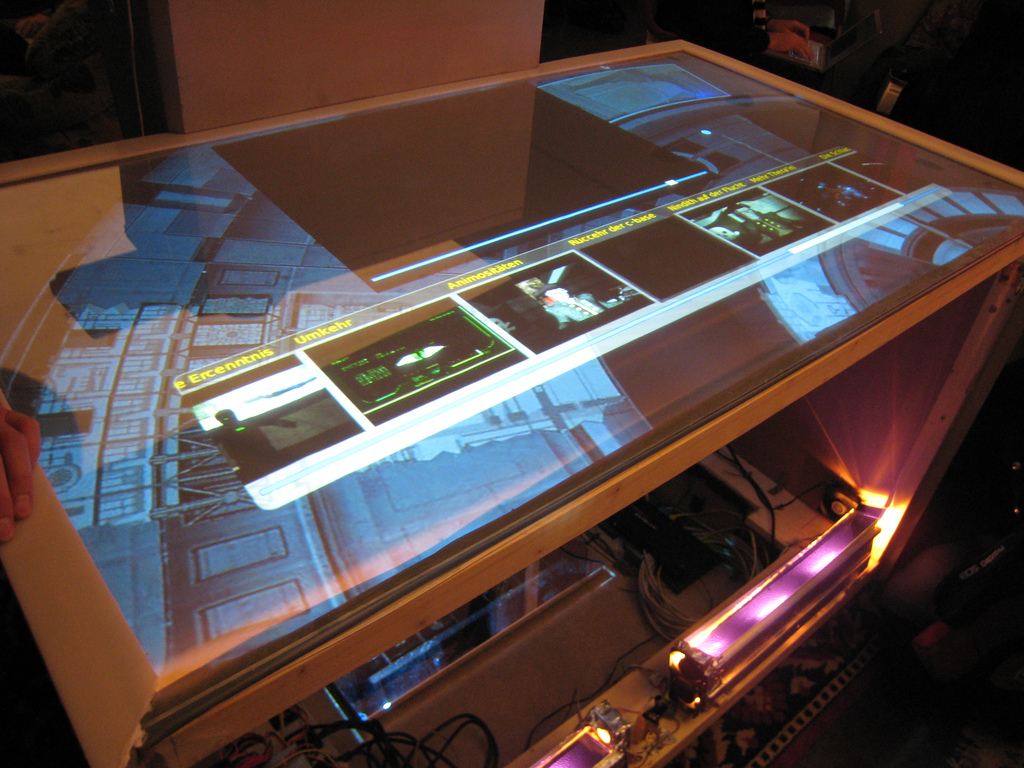
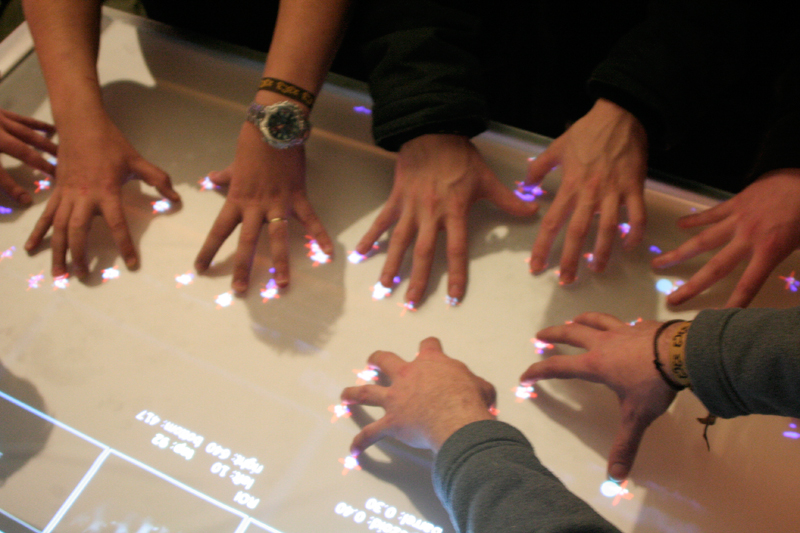
The c-base MultiTouchConsole (mtc) is a touch-sensitive table interface that reacts to more than one touch at a time. Similiar to the works of Jeff Han, previously mentioned here, it interacts at the touch of your fingers. While still a prototype, it is a remarkable product that can be experienced first hand at the Directors Lounge. As Régine puts it, the mtc comes with a couple of benefits, it is robust enough to take a couple of beer bottles (and even understands the difference between bottles and fingers), it is a low cost solution and it´s open source. Interested beings are highly encouraged to get in touch with the mtc crew during Directors Lounge (only till sunday 11th).
The c-base MultiTouchConsole mtc is a completely self-contained, touch-sensitive table built in spare time by a group of c-base members. A projector in the table displays an image on the table surface and an infrared-sensitive camera is used to track positions of fingers touching it. The mtc reacts to an unlimited amount of touches at once. Touch locations are determined with an accuracy of a few millimeters..